Respondr
An AAC device that ensures help
is always one tap away.
Role: UX/UI Designer
Tools: Figma
Course: IXD 415, University of Kansas, 2025
I designed Respondr for people living with ALS, a progressive disease that gradually takes away the ability to speak and move. Most AAC apps aren't built around what ALS patients actually experience day to day. Respondr is a tablet-based emergency communication app that makes critical actions available in one tap, gives first responders instant access to medical information, and automatically alerts emergency contacts, all designed around users with limited motor control.
Why this project?
My grandfather had ALS. Watching him refuse to use AAC apps because they weren't built for what he was actually going through was one of the hardest things I've experienced. People with ALS face emergencies constantly, breathing difficulties, falls, moments where they need help immediately, but can't speak. I wanted to design something that actually fit that reality. RESPONDR is my attempt to do better.
The Problem
People living with ALS progressively lose their ability to speak and control their movements. Most AAC apps are too complex, too slow, and too generic for the emergencies they face daily. Small buttons are impossible to press with limited dexterity. First responders arrive without knowing the patient's medical history. Emergency contacts don't get notified automatically. Every second of delay matters.
The User
Mark Harper, 53. Diagnosed with ALS, living at home with his wife Anna as his primary caregiver.
His goals:
- Communicate quickly in emergencies
- Maintain independence
- Reduce anxiety during breathing difficulties.
His frustrations:
Buttons too small to press
- No automatic alerts
- Caregivers don't have instant access to his medical info.
The Process
Starting with the project brief, I followed a full User-Centered Design process over six weeks. I researched ALS and AAC extensively using CDC data, ALS Association resources, and peer-reviewed academic literature. I attended guest lectures from AAC specialists at George Mason University and the University of Iowa, watched documentaries about ALS patients and their communication challenges, and built a research-backed persona. From there I moved through concept sketches, peer critique sessions, design clinics, mid-fidelity prototypes, a full design library, and finally high-fidelity screens tested through A/B user testing with classmates.


Key Design Decisions
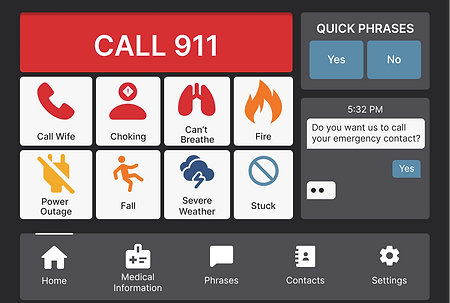
Every decision was made around one question: What does a person with limited motor control need in a moment of crisis? The CALL 911 button is the largest, most dominant element on screen at all times. The Quick Phrases panel keeps Yes and No permanently visible without any navigation. The Emergency Detected screen is full-screen red, no clutter, no confusion, just two large actions. And rather than a static alert, the app walks through a conversational confirmation flow so the user always knows help is actually on the way. Button sizes were also deliberately designed to be large throughout, accounting for users with limited dexterity.

Early Iteration

Final Design
What Changed and Why
A/B user testing with classmates compared icon sizes, color coding, text sizes, and layouts. Feedback consistently pointed toward higher contrast, larger tap targets, and simpler color differentiation between emergency and non-emergency actions. The core structure stayed strong throughout; most changes were refinements in clarity rather than complete overhauls.


The Full Design
Screens covering every critical user need, from emergency alerts to medical profiles and communication tools.
Reflection
This project is personal. My grandfather had ALS, and I saw firsthand how the tools meant to help him fell short. RESPONDR is my attempt to design something that actually fits the life of someone living with ALS, not a generic app, but a tool built around the specific, urgent moments they face every day. If it could make one emergency less frightening for someone like him, that's enough. Going forward, I'd push to test with actual ALS users and caregivers, and expand the app beyond emergencies into daily communication.